





An AI model can write code, analyze a long document, explain complex ideas, and reason through a problem. But ask it a much simpler question, such as “What happened in my team's meeting yesterday?” and suddenly, it may know nothing.
The problem isn't necessarily intelligence. It is access. The information might exist in a meeting transcript, while another part is stored in a project management tool and the latest numbers are sitting in a database. The AI simply isn't connected to any of them. As developers started building more useful AI applications, this became a much bigger problem than it first appeared.
AI Had an Access Problem
Large language models don't automatically have access to your private files, company databases, software tools, or internal applications. Developers therefore had to find ways to give them access.
Suppose you were building an AI assistant for a company. First, employees wanted it to search internal documents, so you built an integration. Then they wanted it to retrieve customer information, which required another integration. Soon they wanted access to code repositories, calendars, development tools, business applications, and external services. Each connection could have its own API, authentication method, data format, and implementation.
One AI application connected to a few systems was manageable. But the AI ecosystem wasn't heading toward one application connected to a few systems. It was heading toward thousands of AI applications interacting with thousands of tools and data sources. That raised a much bigger question: Does every AI application need to build these connections from scratch?
Model Context Protocol Offered Another Approach
In November 2024, Anthropic introduced an open-source project called Model Context Protocol, or MCP. The idea was to create a more standardized way for AI applications to connect with external systems.
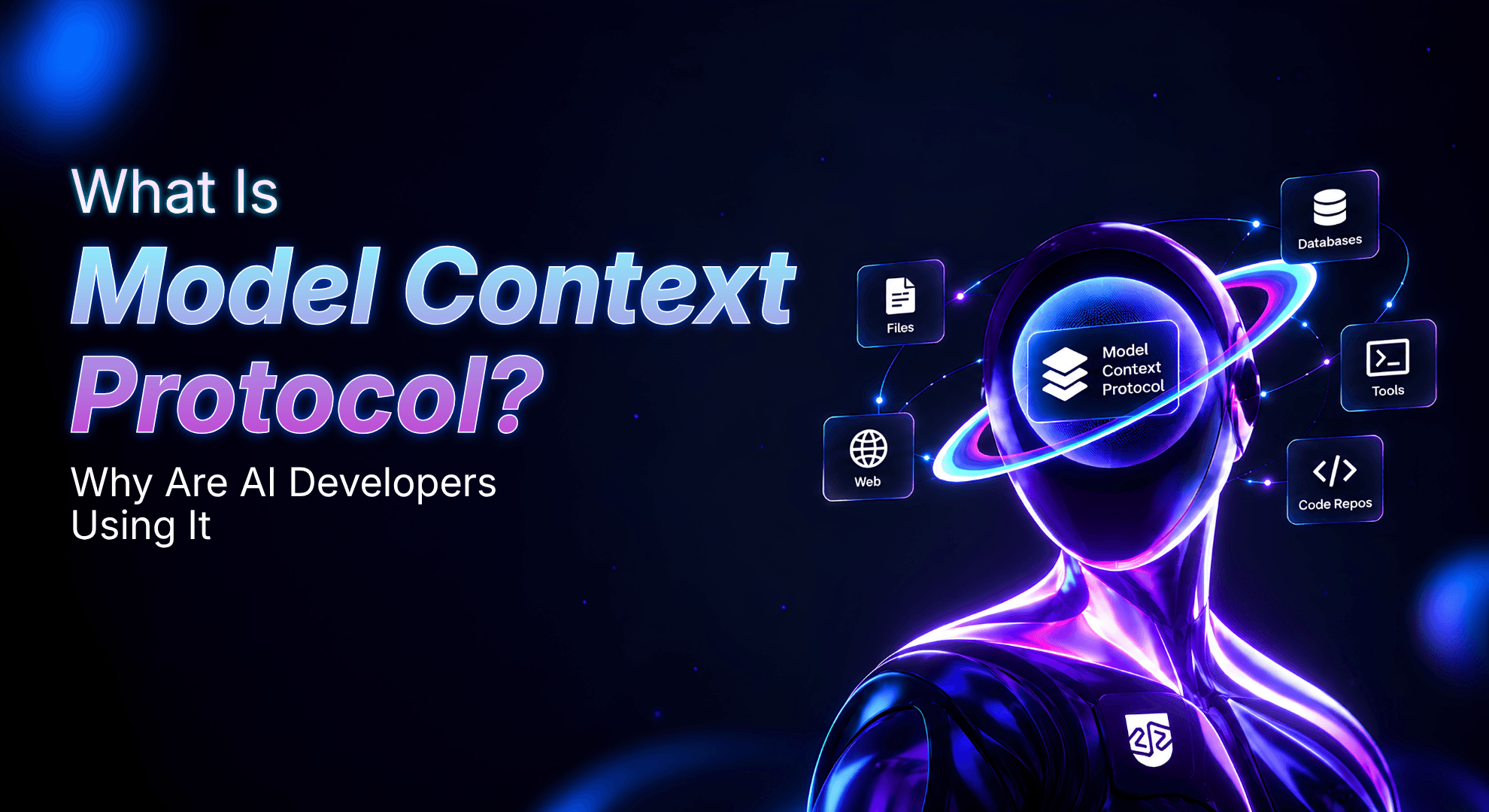
In simple terms, Model Context Protocol is an open protocol that allows AI applications to discover and interact with external tools, data sources, and other capabilities through a common interface. Instead of every AI application inventing its own way of interacting with every external capability, MCP defines a common protocol that both sides can understand.
This is why MCP is sometimes compared to USB. USB didn't create keyboards, cameras, or hard drives. It created a standard way for different devices to connect to computers. MCP is attempting something conceptually similar for AI applications. The analogy isn't technically perfect, but the idea is useful: standardize the connection instead of reinventing it every time.
So How Does MCP Actually Work?
Imagine an AI coding assistant that needs to interact with development tools. With MCP, there are three important components: the MCP host, MCP client, and MCP server.
The host is the AI application or environment coordinating the interaction. An MCP client maintains communication with an MCP server, while the server exposes capabilities that the AI application can use. In simplified form, you can think of the connection as AI application → MCP client → MCP server → external system.
MCP servers can expose different kinds of capabilities, including resources, tools, and prompts. Resources can provide useful context or data. Tools allow the AI system to perform operations, while prompts provide reusable templates for interactions. The external systems themselves don't need to work in exactly the same way. MCP provides a shared protocol through which compatible applications and servers can communicate.
But Didn't We Already Have APIs?
Yes, and MCP does not replace APIs. APIs have been connecting software systems for decades. If an application needs to retrieve information from another service, that service might provide an API defining what requests can be made and what information will be returned.
MCP solves a related but different problem. An API essentially answers, “How can software interact with this particular service?” MCP helps answer, “How can an AI application consistently discover and use the tools and context available to it?”
An MCP server may even use existing APIs behind the scenes. In that case, the architecture could look something like AI application → MCP → existing API → service. APIs continue doing what they already do, while MCP provides an additional standardized layer designed around AI applications and their interactions with external capabilities.
Then AI Agents Changed the Stakes
Connecting AI to external information was already useful. Then AI systems started becoming more agentic. A chatbot primarily generates a response, but an AI agent can potentially take actions.
Give an agent a goal and it might need to search documents, inspect a database, use a development tool, call an API, update another application, and evaluate what happened before deciding what to do next. Consider an AI coding agent asked to fix a software bug. It may need to understand the task, inspect the codebase, search documentation, use development tools, run tests, and check whether the solution actually worked.
The model provides part of the intelligence, but the useful work depends on its ability to interact with systems outside the model. MCP gives developers a standardized way to expose some of those capabilities. This helps explain why Model Context Protocol has become closely associated with the rise of AI agents and tool-using AI systems.
MCP Started Moving Beyond Anthropic
MCP began as an Anthropic-led open-source project, but its significance grew as adoption spread beyond Anthropic's own products. Developers started creating MCP servers for different tools and services, while other AI development platforms began adding MCP support.
OpenAI, for example, added MCP support to its Agents SDK and later introduced support for remote MCP servers in its Responses API. Meanwhile, the protocol itself continued evolving, with work covering areas such as authorization, extensions, SDKs, and more flexible architectures.
That broader adoption matters because protocols become much more useful when both sides of an ecosystem support them. More MCP-compatible servers give AI applications more capabilities they can potentially connect to. More MCP-compatible applications give developers more reason to expose tools through MCP. This is how a technical standard can begin developing network effects.
But Giving AI More Access Creates Another Problem
Suppose an AI agent can access your company's systems through external tools. Now imagine it can also take actions inside those systems. Suddenly, the problem isn't simply connectivity.
Developers have to decide what information the agent can access, which tools it can use, who can authorize those connections, and which actions require human approval. They also need to consider what happens if a tool or MCP server is malicious, compromised, or simply behaves in an unexpected way.
MCP includes mechanisms and guidance around authorization and security, but using the protocol does not automatically make an AI application secure. Developers still need appropriate authentication, permissions, access controls, monitoring, and safeguards. These considerations become increasingly important as AI moves from reading information to taking actions.
Why Are AI Developers Using MCP?
The appeal of MCP ultimately comes down to interoperability. Developers are building an ecosystem in which AI models need to interact with databases, code repositories, files, development environments, enterprise applications, and countless other systems.
Building every connection independently creates duplicated work. A shared protocol offers another approach: expose capabilities through a standardized interface so that compatible AI applications can interact with them without every pairing requiring a completely different integration design.
MCP does not eliminate integration work. Developers still need to build servers, manage authentication, define tools correctly, handle permissions, and secure their systems. What it provides is a common foundation on which those integrations can be built.
Where Does MCP Go From Here?
MCP began as a way to connect AI applications to external data and tools. But as AI becomes more agentic, that role is expanding. Future agents will need to discover tools, access company systems, and take actions across applications, all while managing permissions and security.
MCP is already evolving in this direction, with a growing focus on agent communication, enterprise security, and scalable infrastructure. Its move to the Agentic AI Foundation under the Linux Foundation also positions it as a broader industry project rather than a protocol controlled by one company.
Whether MCP becomes the dominant standard remains uncertain. But the problem it addresses is only getting bigger. As AI moves from answering questions to taking actions, models will need safe, standardized ways to interact with the software world around them.
The first era of AI was about making models smarter. The next may be about connecting them to everything else.