





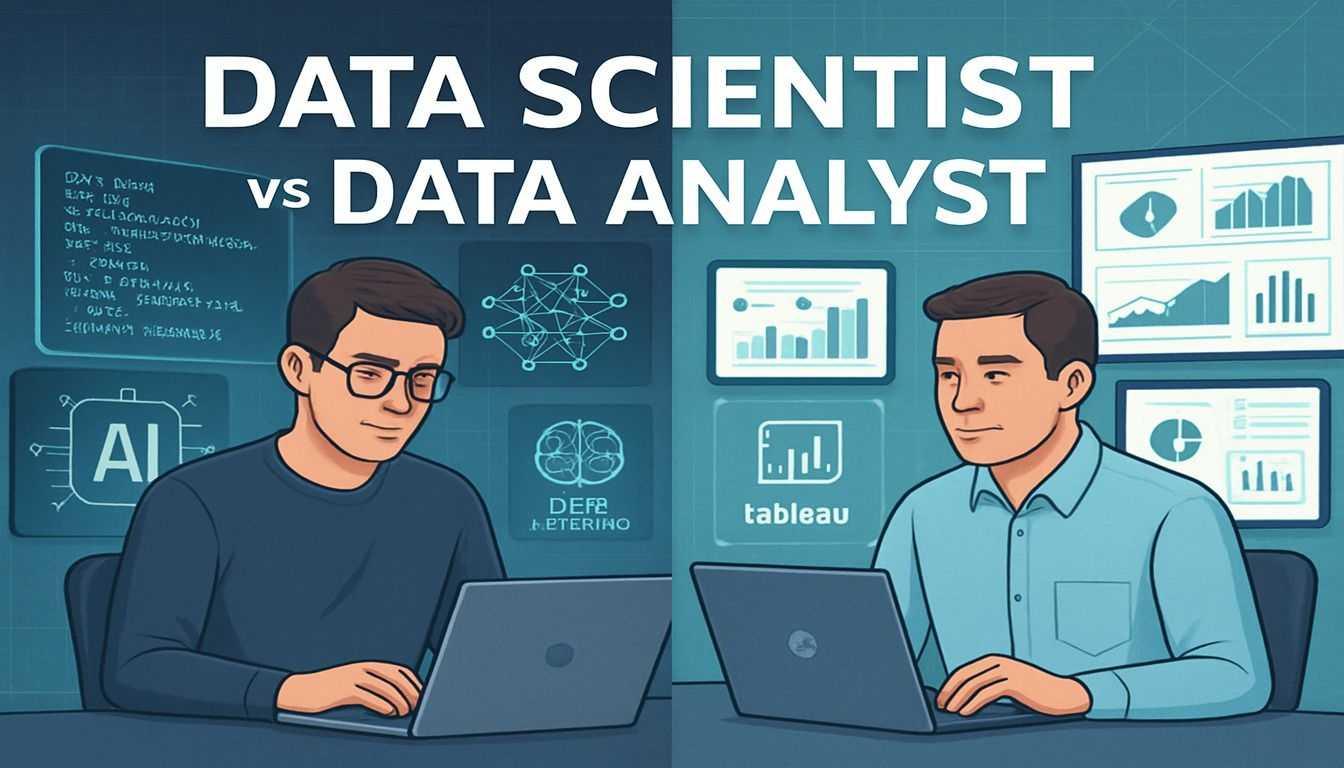
When it comes time for students and professionals to choose a career, many options often start floating in their minds. Some are attracted to the world of analytics, while others see possibilities in the complexity of machine learning and data modeling. Think in detail, on one side there is a data analyst who analyzes data, and on the other side there is a data scientist who uncovers the deep secrets hidden in the data. Here the question arises - data scientist vs data analyst, who should be chosen?
Data Science vs Data Analytics: Basic Differences
Data Science
Data science is a field where maths, statistics, programming and machine learning techniques are used to derive patterns, trends and insights from large amounts of data. In comparison to data scientist vs data analyst, the scope of data scientists is much larger as they are not limited to just reporting or interpretation, but also predict future possibilities.
Data Analytics
Data Analytics mainly focuses on finding answers to business questions by analyzing data obtained from a business's website, app or business processes. Here, especially the person whom we call a data analyst plays his role.
Data Scientist and Data Analyst: Responsibilities and Skills
| Profile | Key Responsibilities |
| Data Scientist | Clean and analyze data, Create machine learning models, Perform predictive analysis by finding patterns, Extract new insights, Use advanced analytical tools |
| Data Analyst | Collect and organize data, Create dashboards, Prepare reports, Analyze pros and cons, Use simple statistical tools |
- Data scientists are responsible for extracting valuable insights and predictive models, while data analysts work on answering business-related questions.
- Data scientists use advanced techniques to predict what might happen next, while data analysts prepare trends and reports based on old data.
- Data science is much larger in scope than the task of conducting data analytics, as it focuses not just on analysis, but on modeling, AI, automation, and prediction.
Degree, Qualification and Required Skills
Data Scientist
- Strong maths, statistics, programming (Python, R), understanding of machine learning.
- BSc/MSc/BTech Computer Science, Mathematics, Data Science etc.
- Advanced programming and data visualization tools (Tableau, Power BI).
Data Analyst
- Basic statistics, programming (Excel, SQL, sometimes Python/R).
- Graduation and analysis skills.
- Presentation and report making skills required.
Salary and Career Growth - “Who gets paid more?”
- Data scientists earn more than data analysts, as their role is complex, technical and more demanding.
- In India, the salary of a starting data analyst is ₹4 to ₹6 lakh per annum, while data scientists start from ₹7 to ₹10 lakh per annum, and the salary of experienced professionals goes much higher than this.
- Globally, the average package of data science profiles is higher than that of data analysts.
Data Science vs Data Engineering
The difference between data science vs data engineering is that data engineering profiles focus on creating data collection, storage, transfer and processing infrastructure, while data scientists extract information and models from that data.
Data Scientist vs Data Analyst - Real World Example
Suppose, there is an e-commerce company:
- The data analyst can check which product had the highest sales in which month. He makes reports by analyzing things like sales numbers, return rate or customer demography.
- The data scientist can create models based on these patterns and tell the company that in which range the demand for which type of products will increase or which customer can buy which product in the future.
Start your data science and data analyst career at Saras AI
- You can start with Powers of AI, 8 Weeks, beginner-friendly certifcation course from Saras AI.
- After that you can Pursue Associate of Science in AI from Saras AI.
- And the you can Pursue Bachelor of Science in AI.
Frequently Asked Questions (FAQs)
Q1. Which is better, data analyst or data scientist?
Ans. Which profile is "better" will depend entirely on your interests and goals.
- If you are comfortable with analysis, reporting, and answering business questions, then a data analyst is a good choice.
- But if you like programming, machine learning, advanced maths, and are interested in future predictions, then a data scientist is better for you.
Q2. Who gets paid more, a data analyst or a data scientist?
Ans. Simply put, data scientists earn more than data analysts because their work involves both technical and domain knowledge and the value addition is also higher.
Q3. Is 30 too old for data science?
Ans. Not at all! There are many examples in the industry where professionals have made a career in data science even after the age of 30. What is important is your commitment to learning, updating skills, and trying your hand at good projects*.
Q4. Does a data scientist do coding?
Ans. Yes, data scientists need to know coding. They use Python, R, SQL and libraries like Pandas, NumPy, scikit-learn. Coding is an important part of their work.
Data Scientist and Data Analyst: How to Choose?
- If you are a beginner and interested in analytics and reporting, it would be wise to start your career as a data analyst.
- If you enjoy machine learning, big problem solving, coding and learning new things, then the data scientist profile is for you.
- Remember that data science is a dynamic field, so choose either of the two.
Conclusion
- The choice of data scientist vs data analyst depends on the interest, skills and career goals of the individual.
- Data science is much larger in scope than the task of conducting data analytics, so if you want to have full range technical skills and face bigger responsibilities then choose data scientist.
- If you want to become an expert in reporting and decision making analysis, then data analyst will be the appropriate choice.
You can also read: Deep Learning vs Machine Learning: What’s the Difference?