





In today's digital age, Deepfake Technology has become a big topic of discussion. According to the 2025 Identity Fraud Report, deepfake accounts are now responsible for more than 40% of biometric fraud. That is, photos, videos and audio that have been manipulated by AI, it has now become very difficult to distinguish between real and fake.
What is Deepfake Technology?
Simply put, Deepfake is a form of artificial intelligence (AI). It is a technique that can create a video, photo, or audio recording that seems real but has been manipulated with AI.
- Meaning any piece of media created or manipulated by artificial intelligence can be deepfake.
- It is synthetic media → in which images, videos, and audio are edited or generated.
- It uses Generative AI models such as GANs (Generative Adversarial Networks) and Autoencoders.
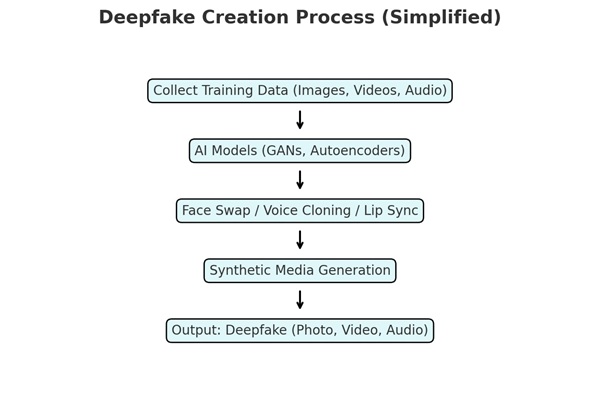
How is Deepfake Creation done?
The process of Deepfake creation is based on AI models.
- Training Data – Thousands of images, videos and audio samples are collected.
- AI Models (GANs/Autoencoders) – Start creating fake content by learning from the data.
- Face Swap, Voice Cloning, Lip Sync – Realistic output is created by blending the real and the fake.
- Synthetic Media Generation – Finally the output is an artificial image or video that looks like the real thing.
Uses of Deepfake Technology
Deepfake Technology is used in many positive and negative ways.
- Entertainment and Film Industry
- De-aging actors in films
- Replacing stunt doubles
- Resurrecting old actors (as seen in Star Wars)
- Advertising and Marketing
- Creating spokespersons in different languages for regional ads
- Creating personalized marketing videos
- Reducing costs with AI avatars
- Fraud and Misinformation
- deepfake-based fraud → Making money by creating fake videos/audios
- Spreading political propaganda and misinformation
- Bypassing biometric systems with fake identities
Want to learn Artificial Intelligence? Enroll Now to Powers of AI an 8 week Beginner Friendly Course.
Deepfake Detectors: How does AI catch fake content?
AI not only creates deepfakes, but deepfake detectors are also based on it.
- CNN (Convolutional Neural Networks): Detecting small inconsistencies in the face
- RNN and LSTM: Analyzing frame-to-frame movements of the video
- Audio Detectors: Detecting unnatural pitch and patterns of voice
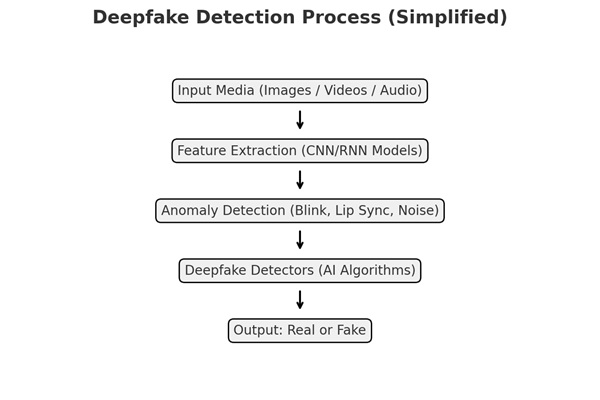
What technology is used to detect deepfakes?
Deepfake detection uses CNN, RNN and advanced AI-based deepfake detectors, which catch small anomalies in videos and audio.
Deepfake Accounts and Fraud Cases
Deepfake accounts are now being used a lot for identity theft and financial scams.
Example: Creating a fake video of the CFO of a company and ordering the bank to transfer money.
This is deepfake-based fraud and its threat is increasing worldwide.
Deepfake and law in India
Now the question arises: Is deepfake legal in India?
- There is no specific law on deepfake in India.
- But laws like IT Act 2000 and IPC (defamation, impersonation) may apply.
Is watching deepfakes illegal?
Just watching a fake video is not considered a crime, but if a person creates such a video or sends it to others with the intention of harming, spreading lies or harassing someone, then he may have to face legal action.
That is:
Just watching = no problem
Making or sharing with wrong intention = legal trouble
When will there be punishment:
- When used to defame someone
- Used for cheating of money
- Made to threaten someone
- Used to spread false rumours
The simple thing is that the intention and the way of using it determines whether it is right or wrong.
What is the difference between Deepfake and AI?
AI (Artificial Intelligence):
- It is a vast technical world
- It works to understand and learn information
- It does many beneficial tasks like medical diagnosis, language translation
- It is like a big umbrella
Deepfake:
- It is a small branch of AI
- It only works to create fake media
- Imitates someone's voice, face or actions
- It is a small part under the umbrella
What is the main difference between the two?
AI is a broad technical field, while Deepfake is a false media created using this technology.
- Misuse of personal information: Misusing someone's face or voice without permission is not right.
- Spread of fake news: Creating political confusion and misleading people through fake videos.
- Mistrust in society: When people come to know that videos can also be fake, they start doubting the real things as well.
- Legal complications: Complete rules and regulations have not yet been made to prevent the misuse of these technologies.
- Mental suffering: People who are subjected to this wrongdoing have to suffer emotional harm.
In the near future, global regulation and better AI detection systems are the solution.
FAQs
Q1. Is deepfake legal in India?
Ans. No, there is no specific law, but IT Act and IPC may be applicable.
Q2. Is watching deepfakes illegal?
Ans. Watching is not illegal, but making or spreading it is a crime if done with wrong intentions.
Q3. What technology is used to detect deepfakes?
Ans. AI-based CNN, RNN and deepfake detectors are used.
Q4. What's the difference between AI and deepfake?
Ans. AI is a technology, Deepfake is its misuse for media manipulation.
Conclusion
Deepfake Technology is both the biggest threat and the biggest innovation of the digital world today. This shows us how real fake media created with today's smart technology - be it photos, clips or voices - look.
There are two aspects to this:
Pros:
- Innovative technologies in show business
- Artistic use in business promotion
- Great visuals at low cost in cinema
Disadvantages:
- Fraud through fake clips
- Spreading false information and spoiling the atmosphere
- Ruining the lives of innocent people
How to solve this:
Developing awareness among people + Powerful detection tools + Stringent legal provisions
This means:
- Telling the general public that such incidents happen
- Developing machines that can detect fake content
- Making strict rules by the administration
Just one solution is not enough, this challenge can be tackled only by combining all three.
You can also Read: Deep Learning vs Machine Learning